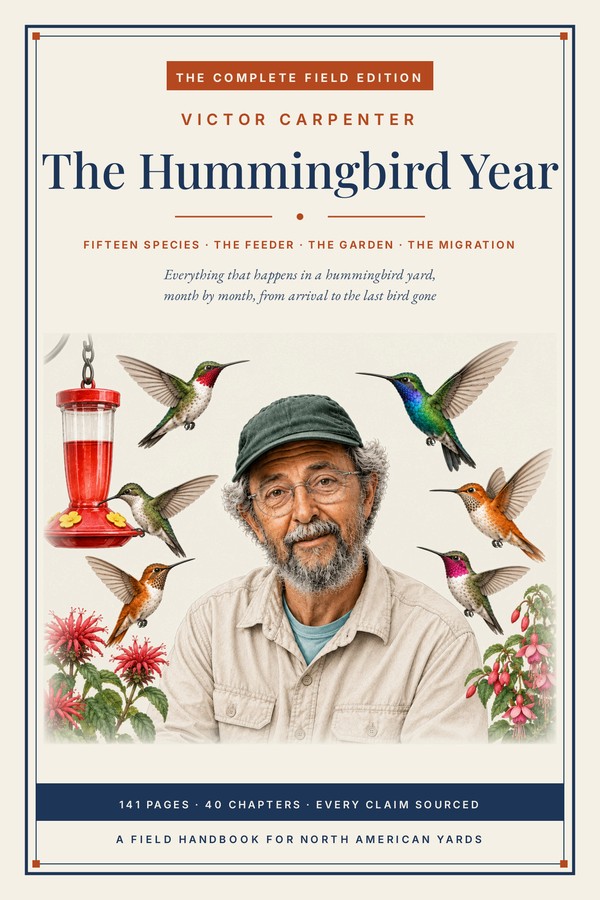
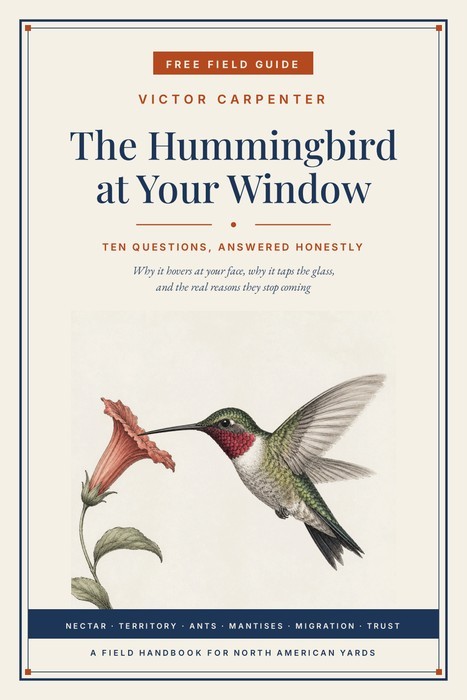
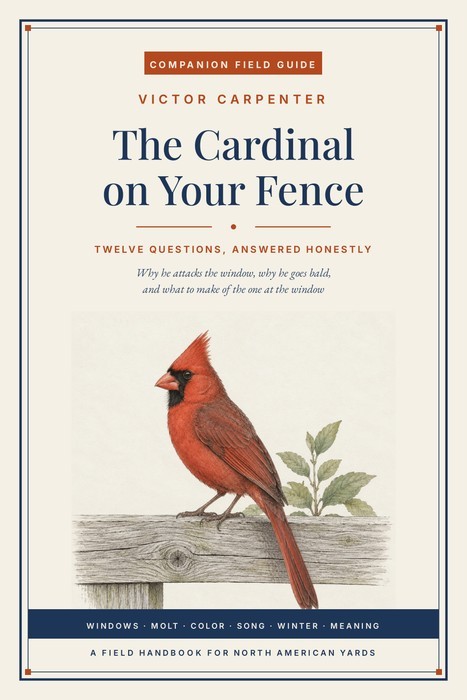
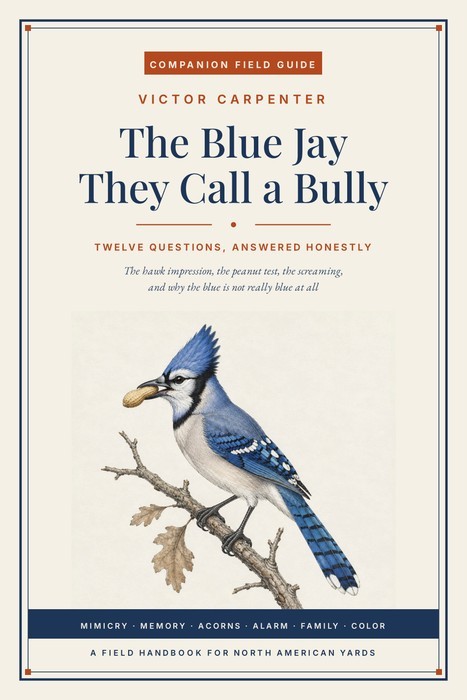
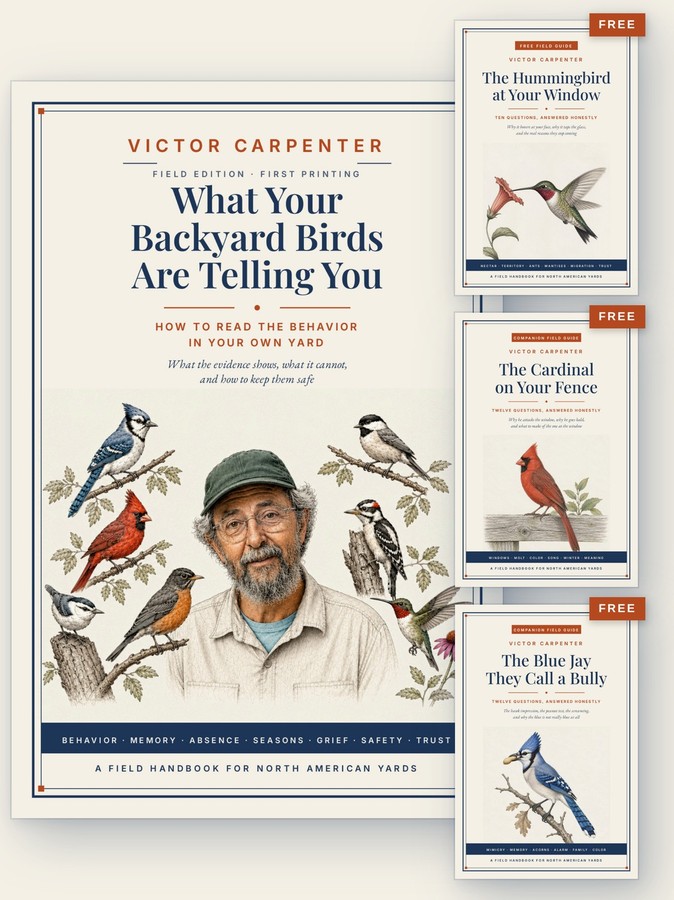
What Your Backyard Birds Are Telling You — cover

Victor Carpenter · Field Edition · MMXXVI

What Your Backyard Birds Are Telling You

Know what you saw. Not what you wish it meant.

A 146-page illustrated handbook that explains what the birds in your yard are actually doing — what the evidence can show, what it cannot, and how to keep them safe.
$19.90$29

Instant PDF download. Read on any device, or print it.

Get the book →

Instant PDF · 7-day refund, no reason needed · Free lifetime updates to this edition

The questions nobody answers

You have watched the same bird for years. You still don’t know what it’s doing.

A cardinal returns to the same fence rail every single morning. A hummingbird flies up, hovers three feet from your face, and leaves. A jay screams a different call when the neighbour’s cat comes out. One day the bird you have fed for six years simply stops coming, and nobody tells you whether that is normal.

Field guides will tell you what the bird is called. They will not tell you what it is doing, whether it knows you, or what you should do about the window it keeps hitting.

That is the gap this book was written to fill.

What you get

Seven parts. Twenty-four chapters. One method.

Every chapter works the same way: what you can actually see, the likeliest explanation, where that explanation comes from, and what the sighting does not prove.

Fourteen behaviors, read closely

The chapter readers come back to. The cardinal at the window. The bird that follows you as you dig. The moment the whole yard goes silent at once.

What they know about you

What a bird can genuinely remember — caching, timing, routine — and the honest answer on whether yours recognises your face.

The hours you don’t see

Night, deep cold, the storm hour, the heat wave. Four windows when your yard is busy and you are not watching.

When a bird stops coming

The most painful unanswered question in this hobby, answered properly: what is likely, what is possible, and what you could never have prevented.

Cardinals, grief and meaning

Handled without endorsing it and without mocking it. Why the experience feels real, and exactly what science can and cannot show.

The kind yard

Windows, cats, hawks, feeder hygiene, mice, and the mesh feeder that freezes birds to death in January. Six chapters of fixable problems.

Why this one is different

Every number in this book has a source. Where the science is thin, it says so on the page.

Most backyard bird content repeats the same handful of numbers without checking them. This book checked them — and where a widely quoted figure did not survive checking, it tells you which one and why.

Commonly repeatedWhat the research saysSource
Crows remember a face for 5 yearsAt least 2.7 years Marzluff et al., Animal Behaviour 79 (2010)
Chickadees drop 22 °F overnightTypically 7 to 18 °F Reinertsen & Haftorn; Sharbaugh
Migrants fly hundreds of miles above your house Mostly below about 2,000 feetRadar migration studies

There is a full sources section at the back — Cornell Lab, the USGS Bird Banding Laboratory, American Bird Conservancy, and the peer-reviewed papers behind every claim. You can check me.

146Pages
24Chapters
30Original illustrations
18Sources cited

Twelve birds, close up

A page each for the birds most likely to be yours

Hand-finished plates, the numbers that matter, three things worth knowing, and the one thing most people get wrong about each species.

Northern Cardinal Black-capped Chickadee Blue Jay American Robin Ruby-throated Hummingbird American Crow

Also inside: Mourning Dove, American Goldfinch, Downy Woodpecker, White-breasted Nuthatch, Carolina Wren and House Finch.

Inside the book

Built to be used outdoors, not admired indoors

Seven-day observation plate
The seven-day method — observe before you change anything in the yard.
Behavior index
Fourteen behaviors, each with what it proves and what it doesn’t.
Window collisions chapter
Why four corner decals do nothing, and what actually works.
Longevity records
Documented maximum ages from banding records — the dove that reached thirty.
Northern Cardinal species page
One of twelve species pages.
Blank yard log forms
Blank field forms at the back, made to be photocopied.

Full contents

Everything in the book

One · Learning to See

  1. Start With the Pattern
  2. The Three-Column Notebook
  3. Fourteen Behaviors, Read Closely

Two · What They Know About You

  1. The Birds That Learn Your Schedule
  2. What a Bird Can Actually Remember
  3. Do They Know Your Face?
  4. The Bird That Follows You Around the Yard

Three · The Hours You Don’t See

  1. Where They Go at Night
  2. The Deep Cold
  3. The Storm Hour
  4. The Heat Wave

Four · Absence

  1. The Empty Feeder, the Empty Fence
  2. Seasons Hide the Birds You Know
  3. When a Familiar Bird Stops Coming
  4. How Long They Actually Live

Five · Meaning

  1. Cardinals, Grief, and Meaning

Six · The Kind Yard

  1. The Kindest Yard Is a Safer Yard
  2. The Feeder You Forget to Clean
  3. Windows Are Not Mirrors to a Bird
  4. Cats, Hawks, and the Ground Below
  5. Mice, Mess, and the Neighbors
  6. If You Have to Stop Feeding

Seven · Trust

  1. Trust Is Built at a Distance
  2. Getting a Chickadee to Your Hand

Reference

  1. Twelve Birds, Close Up
  2. The Emergency Page
  3. The Yard Log — blank forms
  4. Sources and Further Reading

Honestly

Who this is for — and who it isn’t

This is for you if

This is not for you if

You want an identification guide. This book will not help you tell a Downy from a Hairy Woodpecker in the field — buy a photographic guide, or download the Cornell Lab’s free Merlin app, which does it better than any book can. This one starts after you know what the bird is called.

“A likely explanation that knows its own limits is worth more than a confident one that does not.”
Victor Carpenter

The author

“I read every comment. This book came out of them.”

I have watched the same handful of birds come back to the same yard for years. My channel runs on close observation, and the question I get more than any other is some version of: my bird stopped coming — does that mean something?

I don’t have a tidy answer to that, and this book doesn’t pretend to. What I have is a method for separating what I watched from what I want it to mean, and for making the yard a little safer for whatever shows up next.

Two chapters exist only because of readers. The one on a bird that stops coming, because hundreds of people described it and nobody had answered them. And the warning about fine-mesh feeders in freezing weather, because one reader in Alaska described what she found on a January morning.

— Victor Carpenter · bird observer, United States

Questions

Before you buy

What format is it?

A single PDF, 146 pages, sized 6 × 9 inches. It reads well on a tablet or laptop and prints cleanly at home if you prefer paper. Delivered instantly after checkout.

Does it apply where I live?

It is written for North American yards, and the twelve species pages cover the birds common across the United States and southern Canada. The method chapters apply anywhere; the species chapters are regional.

Is this just the videos in written form?

No. Several chapters exist only here — the bird that stops coming, the freezing mesh feeder, the full behavior index, the twelve species pages and the blank field forms. It also corrects three numbers that circulate widely in this niche, including in older videos.

Is the artwork AI-generated?

The illustrations were produced with AI tools and then checked plate by plate against reference photographs for anatomical accuracy — bill shape, field marks, plumage. They are stylised drawings, not identification plates, and the book says so on the page. The research, the writing and the fact-checking are my own.

What if it isn’t what I expected?

Email me and I will refund you, no explanation needed. I would rather have the goodwill than the money.

What you receive

Everything in this edition, delivered at once

146Pages
24Chapters
PDFInstant download
6×9 inPrints at home
EnglishLanguage
FirstEdition, MMXXVI
7 dayrefund

Read it before you decide.

Print the observation sheet. Try the absence log on your own quiet feeder. If it isn’t a fit within seven days, ask for a refund — no form, no reason required.

Updates to this edition are free for life. If a chapter is corrected or a figure redrawn, you get the new file at no charge. Given that this book exists partly to correct numbers other people got wrong, that seemed like the only honest policy.

The birds in your yard have been telling you things for years.

This is the book that translates it.

Get the book — $19.90

Instant download · PDF · 146 pages · Refund on request

What Your Backyard Birds Are Telling You  ·  $19.90 · instant PDF Get the book